

Several RSuDS projects have been run under the umbrella of the Broadland Catchment Partnership since its formation. These schemes aim to reduce surface water flooding, recharge groundwater and provide valuable wetland habitats.
Many are already in place in the catchment but more widespread adoption is sought to improve the effectiveness of existing buffer strips at improving water quality given increasing frequency and intensity of extreme rainfall events.
Rather than relying solely on conventional underground drainage and piped networks, RSUDS aim to slow, store, filter, and safely release rainfall close to where it falls.
These systems can include features such as swales, ponds, wetlands, detention basins, infiltration areas, and restored natural drainage channels. By managing water at or near its source, RSUDS can help reduce surface-water runoff, alleviate flood risk, improve water quality, and support biodiversity. They are particularly valuable in rural environments, where there may be opportunities to integrate drainage measures with agricultural land, natural habitats, and existing landscapes.
You can read more about RSuDS on the Environment Agency’s literature (PDF).
Broadland Run-off Reduction (2017 – 2018)
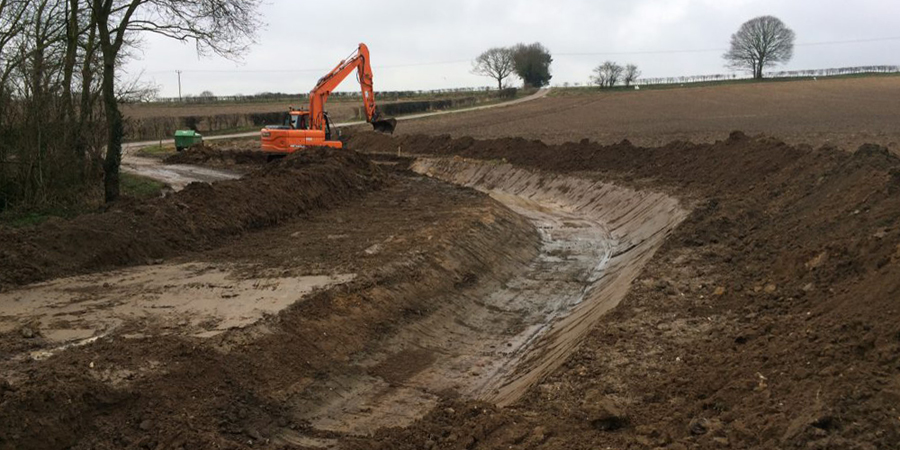
Norfolk FWAG collaborated with the Environment Agency (EA) on the Broadland Run-off Reduction Project to reduce the impact of diffuse pollution that arises from rural land use and reduce nutrients going into the river.
The benefits to the farmer are that the soil will be captured and can be put to beneficial re-use.
A large scheme was designed and constructed by the Norfolk Rivers Internal Drainage Board at Swannington in the Wensum catchment (pictured) as part of the project.
Norfolk Rural SuDS (2016 – 2017)
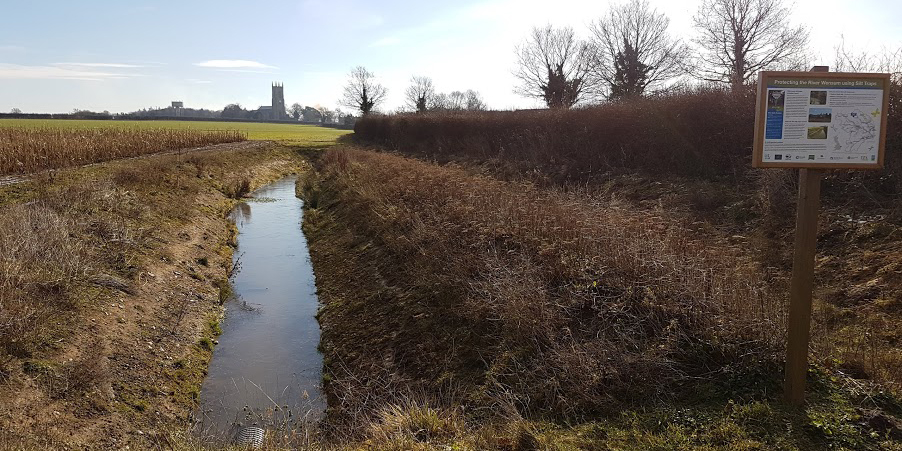
The Norfolk Rural SuDS project constructed three sediment traps on the Salle Estate in 2016, designed by the Norfolk Rivers IDB and funded by the EA and the WWF UK Coca-Cola Freshwater Partnership Water Sensitive Farming project 2016-2018.
They intercept water run-off from local roads and a sugar beet pad that previously flooded a section of road and ran into the Blackwater Drain.
The Blackwater Drain flows into the Wensum and through part of the Broads Executive Area. These waterbodies are protected for their rare and diverse wildlife, also providing drinking water to local communities.
The silt traps receive and slow down a large volume of water which allows sediment and suspended solids to settle out and clearer water to discharge to the drain. The solids can have pollutants attached to them and can also smother gravels that are an important habitat for river flies and fish such as brown trout. The traps can be maintained by using a digger to remove the solids that accumulate.
The UEA monitored the effect of these schemes on water quality as part of the DEFRA Demonstration Test Catchments programme. They are being used as a demonstration site and local farmers have visited these during a knowledge exchange event in order to encourage greater subsequent uptake by farmers, land managers and highways engineers.
Slow the Flow (2015 – 2016)
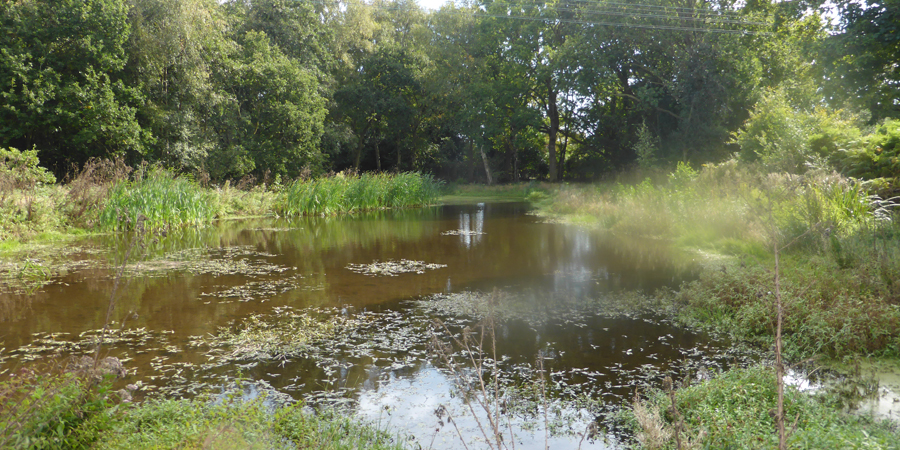
The Slow the Flow project (2015/16) constructed eight RSuDS across the catchment using £31K from Defra’s Catchment Partnership Action Fund (CPAF). These will act as demonstration sites and over one hundred farmers have already visited some of the schemes.
Grants to landowners were promoted by the NFU, CLA, and Agri-tech East. Numerous site visits, liaison between farmers, landowners, and partners including Essex & Suffolk Water, Natural England and Norfolk Wildlife Trust in spring and summer 2015 saw all funds allocated. Work commenced in October 2015. The final schemes were completed in March 2016 using independent contractors and/or the Broads and Norfolk Rivers Internal Drainage Board.
The final schemes were completed in March 2016 using independent contractors and/or the Broads and Norfolk Rivers Internal Drainage Board.